Cost of a Pet CT Scan by Body Area
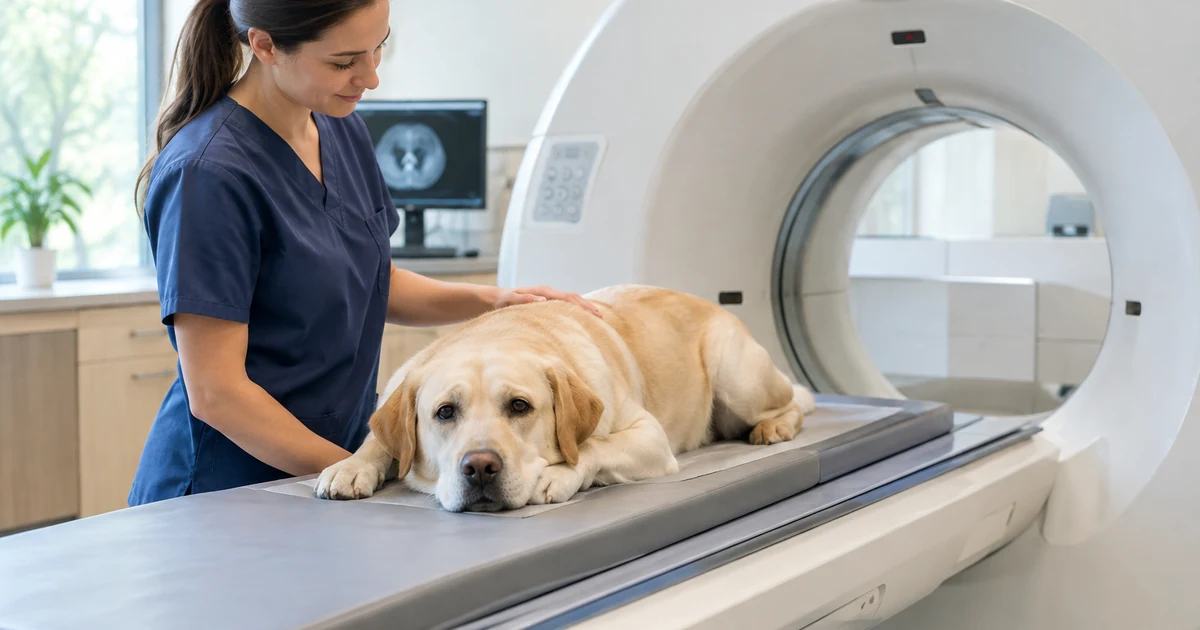
How much of the body is scanned is the main driver of a CT bill, along with whether your pet is a dog or a cat. A CT (computed tomography) scan takes hundreds of thin x-ray slices and turns them into a detailed 3D picture, so the radiologist can see bone, the nose and sinuses, the chest and the abdomen far more clearly than on standard x-rays.
| Area scanned | Dog (medium, with contrast) | Cat (with contrast) |
|---|---|---|
| Head (nose, sinuses, ears, skull, teeth) | $1,500–$3,000 | $800–$1,900 |
| Chest (lungs, checking for spread of cancer) | $1,500–$3,000 | $800–$1,900 |
| Abdomen (organs, masses, urinary tract) | $1,600–$3,100 | $900–$2,000 |
| Spine or one limb / joint | $1,500–$3,000 | $800–$1,900 |
| Two regions (for example chest + abdomen) | $1,900–$3,900 | $1,100–$2,400 |
| Whole body (trauma, cancer staging) | $2,300–$4,500 | $1,300–$2,800 |
Most dog owners pay about $2,200 for a single-region CT with contrast at a private specialty hospital, including anesthesia, pre-anesthetic bloodwork and the radiologist’s report. PetMD and Lemonade both put a dog CT scan at $1,500–$3,500, and Spectrum Care reports an average of about $2,400. The split by area above is our estimate built from those national totals: larger studies mean longer anesthesia and more images to read.
For a quick national benchmark, CareCredit’s 2025–2026 procedure cost study lists an average CT of about $1,615 for dogs and $1,144 for cats. Specialty-hospital quotes that bundle contrast, pre-tests and a board-certified radiologist’s read often run higher than that average.
How Much Do Cat Scans Cost?
“CAT scan” is simply the older name for a CT scan (computerized axial tomography), whether the patient is a person, a dog or a cat. For pets, a CT scan usually costs $1,500–$3,500 for dogs and $800–$2,000 for cats.
Cats tend to cost less because they’re small: they need less anesthetic, scans are quick, and some hospitals image a cat’s whole chest and abdomen in one short study. Vety reports cat CT scans at about $500–$1,200 at veterinary teaching hospitals, $800–$2,000 at private specialty clinics and $1,000–$2,500 or more at emergency hospitals, with a national average total of roughly $1,000–$1,500.
Cats are often scanned for nasal and sinus disease, ear disease, chest problems and to check whether a tumor has spread. If your cat only needs a first look at the chest or abdomen, your vet may start with cat x-rays, which cost a fraction of a CT.
What’s Included in the Price
CT scans are done at specialty hospitals, university hospitals, some larger general practices and mobile CT units. A complete dog CT bill usually includes:
- Exam or specialist consultation: $100–$300 at a specialty hospital (a general-practice office visit is about $40–$80).
- Pre-anesthetic bloodwork: $100–$200.
- Chest x-rays before anesthesia (not always needed): $150–$250.
- General anesthesia or heavy sedation, IV catheter, fluids and monitoring: $200–$500, more for large dogs.
- The CT scan itself: about $800–$1,500 per study.
- IV contrast (iodine-based dye): usually adds $150–$500; some hospitals charge more.
- Board-certified radiologist interpretation: $150–$350.
- Recovery monitoring: $100–$200; an overnight stay adds about $100–$600.
For cats, Vety lists the scan at about $500–$1,500, anesthesia at $150–$500, contrast at $100–$300 and the radiologist’s review at $100–$300. Always ask whether a quote is “all in” or covers only the scan.
What Affects the Cost of a Pet CT Scan
Area scanned
One focused region, such as the nose or chest, costs the least. Two regions or a whole-body scan take longer, need more anesthesia time and give the radiologist more images to read.
Contrast
Lemonade notes that contrast is injected into a vein before the scan and raises the cost. It’s used in many soft-tissue, tumor and abdominal studies, and less often for simple bone questions.
Species, size and weight
Cats and small dogs need less anesthetic. Large and giant dogs need more drugs, fluids and sometimes longer scan times, so expect the top of each range.
Anesthesia, age and health
Pets must stay perfectly still, so most get general anesthesia or heavy sedation, and Spectrum Care notes some focused studies can be done with lighter sedation or a short anesthesia. Senior pets or pets with heart, kidney or breathing problems may need extra tests and closer monitoring.
Facility type and timing
University hospitals and mobile CT units are often at the lower end. Private specialty hospitals charge more, and an emergency CT, for example after a car accident, costs more than a scheduled outpatient scan, as both PetMD and Lemonade point out.
Region
Big coastal cities usually cost more than smaller towns. Few rural clinics have a CT scanner, so you may need to travel. Our estimator adds a region adjustment automatically.
CT Scan Cost by Facility Type
| Facility | Dog CT (one region) | Cat CT (one region) |
|---|---|---|
| Veterinary teaching hospital | $1,400–$2,800 | $500–$1,200 |
| Mobile CT unit / standalone imaging center | $1,500–$3,000 | $400–$1,000 |
| Private specialty hospital | $1,550–$3,100 | $800–$2,000 |
| Emergency / after-hours | $2,000–$4,000 | $1,000–$2,500+ |
Dog figures for teaching and emergency hospitals are our estimates from the national range; mobile-unit and cat figures come from Vety’s 2026 price guides. One private animal hospital, for example, lists dog and cat CT scans starting at about $2,500, covering the IV catheter, anesthesia and fluids, which shows how much individual quotes vary.
CT Scan vs. MRI vs. X-Ray: Cost Compared
CT sits between x-rays and MRI in price. Your vet or specialist picks the test that answers the question for your pet, and often starts with the simpler ones.
| Imaging test | Typical dog cost | Anesthesia? | Best at showing |
|---|---|---|---|
| X-rays (2–3 views) | $150–$400 | Sometimes sedation | Bones, chest, many swallowed objects |
| Ultrasound | $300–$800 | Rarely | Abdominal organs, the heart |
| CT scan | $1,500–$3,500 | Usually | Bone detail, nose and sinuses, chest, surgical planning |
| MRI | $2,500–$5,000 | Always (general) | Brain, spinal cord, discs, soft tissue |
PetMD notes that CT is faster, more widely available and cheaper than MRI and gives excellent detail of bony areas, while MRI shows more soft-tissue detail. That’s why brain and spinal cord problems usually go to MRI; see our dog MRI cost guide. For a first look at bones or the chest, see our dog x-ray cost guide, and for the abdomen or heart, dog ultrasound cost.
Could pet insurance cover a bill like this?
Accident & illness plans typically reimburse 70–90% of eligible vet costs after the deductible, if the condition is not pre-existing and the waiting period has passed. Premiums for dogs average about $62/month and for cats about $32/month (NAPHIA, 2025).
Coverage is subject to each policy’s terms, exclusions and state availability.Does Pet Insurance Cover a CT Scan?
Accident-and-illness policies usually reimburse a CT scan, and the sedation or anesthesia needed for it, when it’s used to diagnose or treat a covered accident or illness, after your deductible and at your reimbursement rate.
- Pre-existing conditions are excluded: if signs of the problem appeared before enrollment or during the waiting period, the scan will likely not be covered.
- Waiting periods: most insurers have short waiting periods for accidents and illnesses, and some have longer ones for orthopedic conditions.
- Annual limits: a CT plus surgery or cancer treatment can use up a low annual limit quickly.
- Accident-only plans: may cover a CT after an injury, such as a fall or car accident, but not for an illness.
- Wellness add-ons: these cover routine care and don’t pay for diagnostic CT scans.
Coverage is subject to each policy’s terms, exclusions and state availability. Compare the numbers in our guide on whether pet insurance is worth it.
When a Pet Might Need a CT Scan
Vets usually refer a dog or cat for CT after an exam, bloodwork and x-rays or an ultrasound haven’t given enough detail. PetMD lists common reasons such as tumors, nasal and sinus disease, inner ear disease, injuries, internal bleeding, complex fractures and back injuries. CT is also often used to plan surgery or to check whether cancer has spread.
Contact your vet or an emergency hospital now if your pet has been hit by a car or had a bad fall, is struggling to breathe, collapses, has a nosebleed that won’t stop, or suddenly can’t walk. An emergency team will stabilize your pet first, and imaging comes after that. See our emergency vet cost guide.
What to Expect on CT Day
Because of the anesthesia, most hospitals ask you to withhold food for a set time beforehand; follow their instructions. Your pet is examined, has pre-anesthetic bloodwork if it wasn’t done recently, then gets an IV catheter and anesthesia or sedation.
The scan itself is usually much quicker than an MRI, often only minutes of scanning, though the whole visit with preparation and recovery can take several hours. Many pets go home the same day, a little sleepy. Ask when the radiologist’s report will be ready and who will go over the results with you.
Questions to Ask Before a CT Scan
- Which areas will be scanned, and will contrast be used?
- Is the estimate all in: exam, bloodwork, anesthesia, scan, contrast, radiologist’s read and recovery?
- If a biopsy or other procedure is likely, can it be done under the same anesthesia, and what would that add?
- Can recent bloodwork and x-rays from my regular vet be used instead of repeating them?
- When will the results be ready, and is a follow-up consult included?
How to Save Money on a Pet CT Scan
- Compare facilities: prices vary by over a thousand dollars between hospitals; ask about veterinary teaching hospitals and mobile CT units near you.
- Schedule when it’s safe to: a planned outpatient scan usually costs less than an emergency one, but never delay care your vet says is urgent.
- Ask for an itemized estimate so you can see what each part of the bill covers.
- Bring recent records: recent bloodwork and x-rays may avoid repeat tests.
- Combine procedures: ask whether biopsies, dental work or other planned procedures can be done under the same anesthesia.
- Use financing: most specialty hospitals accept CareCredit or Scratchpay.
- Insure early: an accident-and-illness policy started while your pet is young and healthy is the most reliable way to have a future CT covered.
Frequently Asked Questions
How much is a CT scan for a dog?
Most dog CT scans cost $1,500 to $3,500 including anesthesia, pre-anesthetic bloodwork and the radiologist’s report, and a single-region scan with contrast typically comes to about $2,200 at a private specialty hospital. Whole-body or emergency scans can exceed $4,000.
How much do cat scans cost?
A “CAT scan” is another name for a CT scan. For pets, it usually costs $1,500–$3,500 for a dog and $800–$2,000 for a cat, depending on the area scanned, contrast and the facility.
Why is a CT scan cheaper than an MRI for pets?
CT machines are more widely available and scans are much faster, so anesthesia time is shorter. CT shows bone, the nose and sinuses and the chest very well, while MRI gives more detail of the brain and spinal cord. Your vet will suggest the scan that answers the question for your pet.
Does my pet need anesthesia for a CT scan?
Usually, yes. Pets must stay completely still, so most get general anesthesia or heavy sedation with an IV catheter and monitoring. Many go home the same day after a few hours of recovery.
What does contrast add to a CT scan?
An iodine-based contrast dye is injected into a vein so blood vessels, organs and masses show up more clearly. It usually adds about $150 to $500 to the bill, and many soft-tissue studies use it.
Does pet insurance cover CT scans?
Accident-and-illness policies usually reimburse a CT scan and the sedation needed for it when it diagnoses a covered condition, after the deductible. Pre-existing conditions and problems that began during the waiting period are excluded. Coverage is subject to each policy’s terms, exclusions and state availability.
Not veterinary advice. Prices are estimates for budgeting, not quotes. Ask your veterinarian for a written, itemized estimate. If your pet is injured, in pain or acting unwell, contact your vet or an emergency animal hospital right away.