Dog MRI Cost by Body Area
How much of the body needs scanning is the main driver of an MRI bill, because it sets how long your dog stays under anesthesia and how many image sequences the radiologist reads. Most dog MRIs look at the brain (for example, seizures or a head tilt) or the spine (for example, back pain, wobbliness or sudden weakness in the legs).
| Type of MRI | Scan + anesthesia + radiologist read | Typical all-in total (with consult and pre-tests) |
|---|---|---|
| Brain only | $2,300–$3,300 | $2,700–$4,000 |
| One spinal region (neck or back) | $2,300–$3,300 | $2,700–$4,000 |
| Brain + neck (cervical spine) | $2,700–$3,900 | $3,100–$4,700 |
| Two or more spinal regions | $3,000–$4,400 | $3,400–$5,200 |
| Add a CSF tap (spinal fluid analysis) | Usually adds several hundred dollars | Can exceed $1,000 in some hospitals |
Most owners pay about $3,400 all in for a single-region MRI at a private specialty hospital. National cost guides put a dog MRI at roughly $2,300–$5,000 (PetMD) or $2,500–$6,000 (Lemonade), and one Florida neurology practice reports an average all-in cost of about $5,000. The by-area split above is our estimate built from those totals: larger studies mean longer anesthesia and more images.
Size matters too. A large or giant dog needs more anesthetic drugs and, for spinal studies, often more scan time, so expect the top of each range for big breeds.
What’s Included in the Price
An MRI is almost always done at a specialty or university hospital and involves several separate charges. Ask whether your quote is “all in” or just the scan.
- Specialist consultation and neurologic exam: about $150–$300. The University of Wisconsin veterinary hospital lists $200–$300 for an initial neurology exam.
- Pre-anesthetic bloodwork: $100–$200.
- Chest x-rays (often before anesthesia): $150–$250.
- General anesthesia and monitoring, IV catheter and fluids: about $200–$500, higher for large dogs.
- The MRI scan itself: around $2,000–$2,500.
- Board-certified radiologist interpretation: $150–$350.
- CSF tap (if recommended): often done under the same anesthesia; adds several hundred dollars, and Embrace notes a CSF tap can run upwards of $1,000.
- Hospital stay: a few hours of recovery is standard; an overnight stay adds about $100–$600.
The University of Wisconsin veterinary hospital quoted $3,000–$3,500 for a typical neurologic evaluation including MRI and CSF tap (2021 pricing), which lines up with today’s national ranges.
What Affects the Cost of a Dog MRI
Area scanned and scan time
A focused brain study usually costs less than brain plus neck, and imaging several spinal regions takes longest. If the neurologist needs extra sequences or contrast, the bill rises.
Size and weight
Bigger dogs need more anesthetic drugs and fluids and may need longer scans. Expect giant breeds to cost 15–25% more than small dogs for the same study.
Age and health
Senior dogs or dogs with heart, kidney or breathing issues may need extra tests before anesthesia and closer monitoring, which adds cost.
Facility type
University teaching hospitals and standalone imaging centers are often at the lower end ($2,500–$4,000 per Vety). Private specialty and referral hospitals typically charge $3,000–$6,000, and after-hours emergency MRIs cost the most.
Region
Few hospitals have an MRI machine, so choice is limited in rural areas. Prices in big metro areas on the coasts are generally higher, while some Midwest and Southern teaching hospitals are cheaper; travel can offset the savings.
What comes next
An MRI is often the step before surgery or long-term treatment. Spinal surgery at one university hospital was quoted at about $2,500–$3,000 and brain surgery at $3,000–$5,000 on top of the MRI (2021 pricing), so ask for an estimate that covers both if surgery is likely.
Could pet insurance cover a bill like this?
Accident & illness plans typically reimburse 70–90% of eligible vet costs after the deductible, if the condition is not pre-existing and the waiting period has passed. Premiums for dogs average about $62/month and for cats about $32/month (NAPHIA, 2025).
Coverage is subject to each policy’s terms, exclusions and state availability.Does Pet Insurance Cover a Dog MRI?
Accident-and-illness policies usually reimburse advanced imaging such as MRI when it’s needed to diagnose a covered accident or illness, after your deductible and at your reimbursement rate. Because an MRI bill often lands between $2,500 and $5,000, this is one of the situations where coverage can make a real difference.
- Pre-existing conditions are excluded: if signs of the problem (for example back pain or seizures) appeared before enrollment or during the waiting period, the MRI will likely not be covered.
- Waiting periods: most insurers have a short waiting period for illnesses and some have a longer one for certain orthopedic conditions.
- Annual limits: a low annual limit can be used up quickly by an MRI plus surgery.
- Accident-only plans: may cover an MRI after an injury, such as a car accident, but not for an illness.
Coverage is subject to each policy’s terms, exclusions and state availability. Compare the numbers in our guide on whether pet insurance is worth it.
When a Dog Might Need an MRI
Vets usually refer dogs for an MRI after an exam, bloodwork and often x-rays or an ultrasound haven’t given enough answers, especially for brain and spinal cord problems that x-rays can’t show.
Call your vet or an emergency vet right away if your dog suddenly can’t walk or drags its back legs, has a seizure lasting more than a few minutes or several in a row, shows sudden severe back or neck pain, or loses bladder control. These need urgent care, and an emergency hospital can stabilize your dog before any MRI. See our emergency vet cost guide.
Dog MRI vs. CT Scan vs. X-Ray: Cost Compared
MRI is the most expensive imaging test for dogs, so it usually comes after simpler tests. Each one answers different questions, and your vet or specialist chooses based on what they need to see.
| Imaging test | Typical cost | Anesthesia? | Best at showing |
|---|---|---|---|
| X-rays (2–3 views) | $150–$400 | Sometimes sedation | Bones, chest, many swallowed objects |
| Ultrasound | $300–$800 | Rarely | Abdominal organs, the heart |
| CT scan | $1,500–$3,500 | Usually | Bone detail, nasal cavity, chest, surgical planning |
| MRI | $2,500–$5,000 | Always (general) | Brain, spinal cord, discs, soft tissue |
For many spinal and brain problems, MRI is the test that gives a clear answer, which can save money on repeated cheaper tests. If your dog has already had x-rays or bloodwork, bring those results to the specialist so they aren’t repeated.
What to Expect on MRI Day
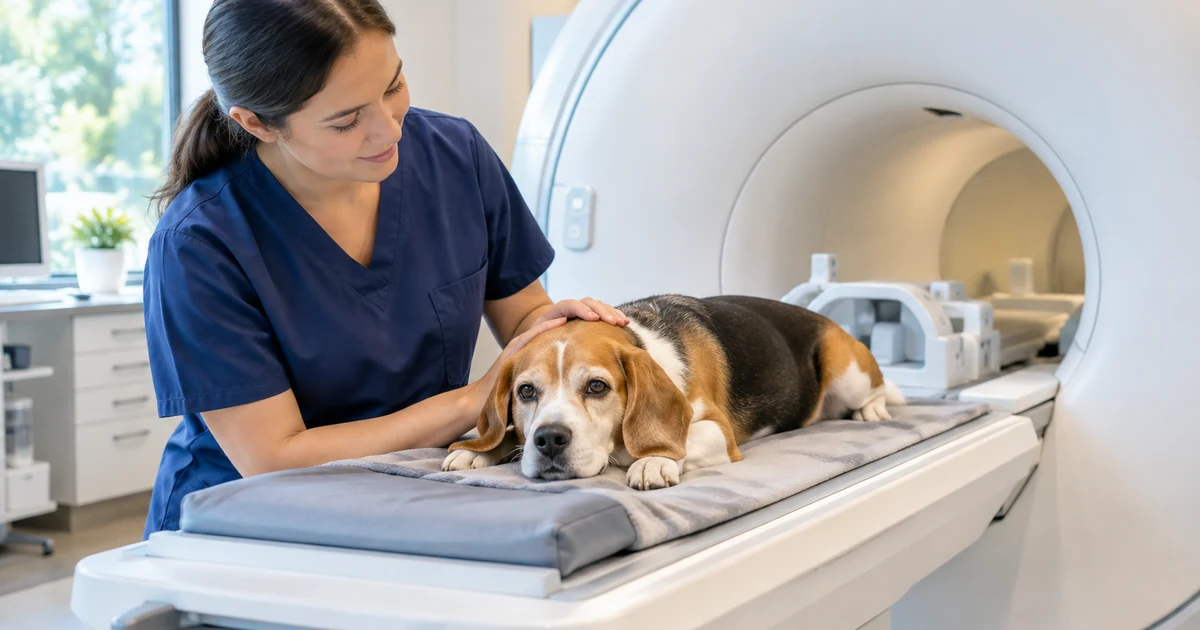
Because of the anesthesia, most hospitals ask you to withhold food for a set time beforehand; follow their instructions. Your dog is checked by the specialist, has pre-anesthetic tests if they weren’t done beforehand, then gets an IV catheter and general anesthesia. The scan itself often takes 45 minutes or more, and PetMD notes that dogs usually stay in the hospital for several hours afterward to recover.
Many dogs go home the same evening and are a little groggy for the rest of the day. How quickly the radiologist’s report comes back varies by hospital, so ask when to expect it. If surgery is needed urgently, some hospitals can operate the same day, which changes the estimate, so ask about this before drop-off.
How to Save Money on a Dog MRI
- Get quotes from more than one facility: MRI prices vary by thousands of dollars between hospitals, even in the same region.
- Check veterinary teaching hospitals: university hospitals are often at the lower end of the price range and have board-certified neurologists and radiologists.
- Ask for an all-in, itemized estimate: consult, pre-tests, anesthesia, scan, radiologist read, CSF tap and hospital stay, so nothing surprises you.
- Bring recent records: recent bloodwork and x-rays from your regular vet may avoid repeat tests.
- Ask about combining steps: if surgery is likely, some hospitals can do it under the same anesthesia as the MRI, which can reduce total anesthesia costs.
- Use financing: most specialty hospitals accept CareCredit or Scratchpay, and some take a deposit with the balance due at discharge.
- Insure early: an accident-and-illness policy started while your dog is young and healthy is the most reliable way to have a future MRI covered.
Frequently Asked Questions
How much is an MRI for a dog?
Most dog MRIs cost $2,500 to $5,000 including anesthesia, pre-tests and the radiologist’s report, and a single brain or spine study typically comes to about $3,400 all in. Multi-region scans, emergency timing and a spinal tap can push the bill past $6,000.
Why is a dog MRI so expensive?
MRI machines are costly to buy and run, and few veterinary hospitals have one. Your dog also needs general anesthesia, monitoring, pre-anesthetic tests and interpretation by a board-certified radiologist, which are each billed.
Does a dog need anesthesia for an MRI?
Yes. Any movement blurs the images, and scans often take 45 minutes or longer, so dogs are placed under general anesthesia with an IV catheter and breathing tube. Most go home the same day after a few hours of recovery.
Is a CT scan cheaper than an MRI for dogs?
CT scans are generally faster and often cheaper, and they show bone and some chest and abdominal problems well. MRI gives much more detail of the brain and spinal cord. Your vet or neurologist will suggest the scan that answers the question for your dog.
Does pet insurance cover a dog MRI?
Accident-and-illness policies usually reimburse an MRI needed to diagnose a covered condition, after the deductible. Pre-existing conditions and problems that began during the waiting period are excluded. Coverage is subject to each policy’s terms, exclusions and state availability.
Not veterinary advice. Prices are estimates for budgeting, not quotes. Ask your veterinarian for a written, itemized estimate. If your pet is injured, in pain or acting unwell, contact your vet or an emergency animal hospital right away.