Savannah Cat Price by Generation
A Savannah’s price depends mostly on its filial generation: how many steps it is removed from the African serval. An F1 has a serval parent, an F2 a serval grandparent, and so on. Earlier generations are larger, rarer and far more expensive.
| Generation | Serval ancestor | Typical pet price | Notes |
|---|---|---|---|
| F1 | Parent (about 50% serval) | $10,000–$20,000+ | Largest and most wild in behavior; males sterile; banned or restricted in many places |
| F2 | Grandparent (about 25%) | $5,000–$12,000 | Still very large and active; males sterile |
| F3 | Great-grandparent (about 12.5%) | $2,500–$8,000 | Often sold to breeders; males usually sterile |
| F4 | Four generations back | $1,500–$5,000 | First generation eligible for TICA championship showing |
| F5 and later / SBT | Five or more generations back | $1,500–$4,000 | Closest to a domestic cat in size; the most common pet Savannah |
| Breeding rights (any generation) | — | Add $1,000–$5,000+ | Usually only sold to established breeders |
These ranges come from published breeder price lists in 2023–2026. Several well-known catteries list F1 pets at $18,000 to $20,000 or more, while others start around $10,000. Females with breeding rights and kittens with strong spotting and tall ears sit at the top of each range.
What “SBT” means
SBT stands for “stud book tradition.” It means the cat comes from at least three generations of Savannah-to-Savannah breeding with no outcross to other breeds. In practice, SBT cats are F4 or later. Percentages like “50% serval” are only a rough guide: a well-bred F5 can look more exotic than a poorly matched F3.
Why early generations cost so much
Producing an F1 means pairing a male serval with a domestic female. Servals are larger, mature later and are often uninterested in domestic cats, so litters are small and unpredictable. Breeders also carry the cost of keeping a wild cat, including permits, specialized housing and exotic-animal vet care. F1 to roughly F4 males are usually sterile, so breeding lines run through females, which keeps female prices high.
First-Year Cost of a Savannah Cat
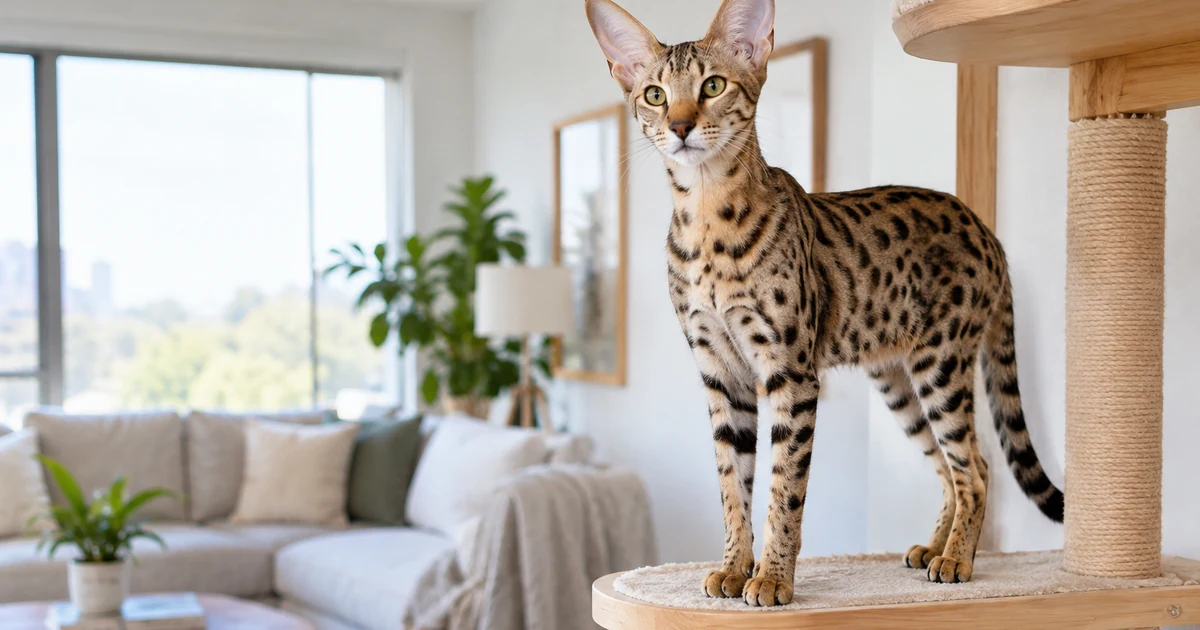
A pet F5 or SBT Savannah is typically 11 to 18 lbs as an adult, about Maine Coon size, while F1 and F2 cats can be considerably larger. They are very active, jump high and need more space, sturdier gear and often more food than an average cat.
| Expense | First-year cost |
|---|---|
| Kitten (pet F5/SBT) | $1,500–$4,000 |
| Kitten vet visits, vaccines, deworming, microchip | $300–$800 |
| Spay/neuter (if not already done) | $200–$500 |
| High-protein food and litter (12 months) | $700–$1,500 |
| Setup: tall sturdy cat tree, large litter box, harness, big carrier, enrichment | $300–$800 |
| Catio or outdoor enclosure (optional) | $1,000–$3,000 DIY; $4,000–$10,000+ professionally built |
| Pet insurance (optional, 12 months, if available) | $300–$720 |
| Typical first-year total | about $2,800–$7,100 (around $4,700 for most owners, before a catio) |
For an F1 or F2, add the higher kitten price and plan for dog-sized gear: an extra-large crate or carrier, a large litter box and heavier furniture. Our guide to cat vet visit costs covers routine kitten bills.
Food costs
Many Savannah breeders recommend a high-protein diet, and some feed raw. Premium wet or raw food for a large, active cat can easily cost $60 to $120 a month, roughly double what a budget diet costs for an average house cat. Ask your vet before switching to raw, since handling and balancing it properly takes care.
Enclosure and space costs
Savannahs are known for climbing, jumping and getting into cupboards. Owners often budget for floor-to-ceiling cat trees, wall shelves, a cat exercise wheel ($150–$500) and childproof latches. A secure catio is a popular way to give outdoor time safely: DIY builds typically cost $1,000 to $3,000, while professionally built catios start around $4,000.
Yearly Cost After the First Year
From year two, most owners of a later-generation Savannah spend about $1,500 to $3,300 a year, or roughly $125 to $275 a month, before any illness.
- Food: $600–$1,400 a year, higher for raw or for large early-generation cats.
- Litter: $200–$400 a year.
- Routine vet care: $250–$600 a year for a wellness exam, vaccines and parasite prevention.
- Pet insurance: $300–$720 a year where available.
- Toys, scratchers and replacements: $150–$300 a year; strong, active cats wear things out fast.
For the bigger picture, see our cost of owning a cat guide.
Is a Savannah Cat Legal Where You Live?
Because Savannahs descend from a wild cat, some states and cities ban them or allow only later generations. The table below reflects state agency pages, state code and published legal guides as of October 2026. Laws and local ordinances change, and counties and cities can be stricter than the state, so verify with your state wildlife or agriculture agency, your city or county animal control and your landlord or HOA before paying a deposit.
| Place | Rule (as of Oct 2026) | Basis |
|---|---|---|
| Hawaii | All Savannahs prohibited | Hawaii Administrative Rules ch. 4-71 (non-domestic animal import rules) bans cat hybrids |
| Georgia | Most exotic cat hybrids, such as Savannahs, are not legal pets | Georgia DNR Law Enforcement, Guide to Legal Pets |
| Iowa | F4 or later only | Iowa Code §717F.1 exempts Savannahs of the fourth or later filial generation |
| Massachusetts | Treated as domestic only if documented F4 or later | State wildlife rules, as summarized by municipal animal control |
| New York State | Reported as F5 or later | Published legal guides |
| New York City | Reported as prohibited | City rules on wild animals and hybrids |
| Alaska, Colorado, New Hampshire, Vermont | Reported as F4 or later | Published legal guides |
| Nebraska, Rhode Island | Reported as banned | Published legal guides; confirm with the state |
| Delaware | Reported as requiring a permit | Published legal guides |
| Texas | Varies by county and city | Local ordinances |
Most other states allow all generations, but city ordinances, rental leases and HOA rules can still restrict them. Keep your cat’s registration papers, because they are how you prove its generation. Outside the US, Australia bans importing Savannahs, and several European countries restrict early generations.
Savannah Health Issues and Their Costs
Later-generation Savannahs are generally robust, but a few issues are worth budgeting for.
| Condition | What it is | Screening cost | Possible cost if affected |
|---|---|---|---|
| Hypertrophic cardiomyopathy (HCM) | Thickening of the heart muscle; Savannahs are considered at elevated risk | Echocardiogram, often $400–$800 with a cardiologist | Cardiology workup, prescribed medication and rechecks; often $3,000–$8,000 over time |
| Progressive retinal atrophy (PRA) | Inherited retinal disease leading to vision loss; screening is recommended in the breed | DNA test $47 at UC Davis | No cure; eye exams and home adjustments |
| Pyruvate kinase (PK) deficiency | Inherited anemia; screening is recommended in the breed | DNA test $47 at UC Davis | Bloodwork, monitoring and, in severe cases, transfusions |
| Swallowed objects | Curious, high-energy cats sometimes eat toy parts or hair ties | — | Surgery to remove a blockage often costs several thousand dollars |
HCM screening
There is no single DNA test for HCM in Savannahs, so reputable breeders have breeding cats scanned by echocardiogram. Ask for dated echo reports on both parents, along with PRA and PK DNA results. Some vets have less experience with early-generation hybrids, so it helps to find a clinic comfortable with large, active cats before you bring a kitten home.
Could pet insurance cover a bill like this?
Accident & illness plans typically reimburse 70–90% of eligible vet costs after the deductible, if the condition is not pre-existing and the waiting period has passed. Premiums for dogs average about $62/month and for cats about $32/month (NAPHIA, 2025).
Coverage is subject to each policy’s terms, exclusions and state availability.Does Pet Insurance Cover a Savannah Cat?
For a later-generation Savannah, insurance generally works like it does for any purebred cat. The US average for a cat accident-and-illness plan is about $32 a month, according to NAPHIA data, though a large purebred may cost more. Early generations are where it gets tricky.
- Eligibility can depend on generation. Some insurers state they have no breed restrictions for cats, but policies don’t always say how they treat F1 to F3 hybrids. Ask the insurer, in writing, whether your cat’s generation is eligible before you rely on a policy.
- Exotic-pet plans are different. Plans sold for exotic or “avian and exotic” pets are often more limited than standard cat policies, so compare annual limits and exclusions carefully.
- Hereditary conditions such as HCM are covered by many but not all cat policies. Check that wording.
- Pre-existing conditions are generally excluded, and illness waiting periods apply after enrollment.
- Legality matters. An insurer may not pay for a pet that is illegal to keep where you live.
Coverage is always subject to the policy’s terms. See our guides to pet insurance cost and whether pet insurance is worth it.
When to Call the Vet Right Away
Contact your vet or an emergency hospital now if your Savannah has fast, labored or open-mouth breathing, sudden weakness or trouble using its back legs, collapse, repeated vomiting, a painful or swollen belly, or may have swallowed a string or toy part. These signs need same-day care. Our emergency vet cost guide explains typical urgent-care bills.
How to Save Money on a Savannah Cat
- Choose an F5 or SBT kitten. They cost a fraction of an F1, are legal in more places and fit ordinary cat gear.
- Ask breeders about retired adults. Spayed or neutered adults are often placed for much less than a kitten.
- Check the law first. Losing a non-refundable deposit, or having to rehome a cat, is the most expensive mistake.
- Compare what’s included: vaccines, microchip, spay/neuter, parents’ echo and DNA results and a written health guarantee.
- Build enrichment yourself. Wall shelves, a DIY catio and rotating toys cost less than buying everything ready-made.
- Pick up the kitten yourself where possible; delivery and flight nannies add hundreds of dollars.
- Plan for big bills with early insurance enrollment or an emergency fund, and know that CareCredit or Scratchpay financing is accepted at many clinics.
- Adjustable escape-resistant cat harness and leashCheck price on Amazon
- Tall heavy-duty cat tree for large catsCheck price on Amazon
- Extra-large enclosed litter boxCheck price on Amazon
How to Spot Savannah Kitten Scams
High prices make Savannahs a prime target for fake listings. Watch for these red flags:
- An “F1” or “F2” kitten for $1,000 to $3,000, far below real breeder prices.
- Payment requested by wire transfer, gift card, crypto or payment apps with no buyer protection.
- No live video call and no chance to visit the cattery.
- Photos that appear on other sites in a reverse image search.
- New “shipping,” “permit” or “insurance” fees after the deposit.
- No TICA registration, no written contract and no documentation of the kitten’s generation.
Frequently Asked Questions
How much is an F1 Savannah kitten?
An F1 Savannah kitten typically costs $10,000 to $20,000 or more from an established breeder, and females with breeding rights can cost more. F1 cats are banned or restricted in several states and cities, so check the law before paying a deposit.
How much is a Savannah kitten?
A pet F5 or SBT Savannah kitten usually costs $1,500 to $4,000, with about $2,600 being typical. F4 kittens run about $1,500 to $5,000, F3 $2,500 to $8,000 and F2 $5,000 to $12,000.
Are Savannah cats legal in every state?
No. As of October 2026, Hawaii prohibits them, Georgia’s DNR lists most exotic cat hybrids as illegal pets, and states such as Iowa and Massachusetts allow only F4 or later. New York City is reported to prohibit them. Rules change and can vary by city or county, so confirm with your state agency and local animal control.
Can you insure a Savannah cat?
Later-generation Savannahs can usually be insured like other purebred cats. Early generations (F1 to F3) may face eligibility questions or exclusions with some insurers, so ask for written confirmation before enrolling. Coverage is always subject to the policy’s terms.
How much does a Savannah cat cost per year?
After the first year, most owners of a later-generation Savannah spend about $1,500 to $3,300 a year on food, litter, routine vet care, insurance and enrichment. Raw diets and large early-generation cats push that higher.
Not veterinary advice. Prices are estimates for budgeting, not quotes. Ask your veterinarian for a written, itemized estimate. If your pet is injured, in pain or acting unwell, contact your vet or an emergency animal hospital right away.