Cat Ultrasound Cost by Type of Scan
The area being scanned is the biggest driver of the price. A quick look at one organ takes a few minutes, while a full abdominal study or a heart scan takes longer and needs more training to read. The prices below are for the scan itself at a general vet, before the exam fee, sedation or lab work.
| Type of ultrasound | General vet | Specialist / radiologist | What it looks at |
|---|---|---|---|
| Focused scan (bladder or one organ) | $150–$300 | $250–$400 | A single area, such as the bladder or kidneys |
| AFAST / emergency “FAST” scan | $100–$250 | Part of the ER workup | A rapid check of the belly for free fluid |
| Full abdominal ultrasound | $250–$500 | $450–$800 | Liver, kidneys, spleen, intestines, bladder, lymph nodes |
| Echocardiogram (heart) | $350–$600 | $500–$900 | Heart walls, chambers, valves and blood flow |
| Pregnancy ultrasound | $200–$350 | $300–$500 | Confirms pregnancy and checks the kittens |
For a typical cat, most owners pay around $400 for a full abdominal ultrasound at a general practice, including the exam. CareCredit’s 2025–2026 Synchrony cost study puts the national average for a cat ultrasound at $323 for the scan, and MetLife Pet reports that most cat ultrasounds cost between $200 and $500.
How Much Does a Cat Echocardiogram Cost?
An echocardiogram is an ultrasound of the heart. Cats are often referred to a board-certified cardiologist for it, because measuring heart walls and blood flow in a small, fast-beating feline heart takes specialized skill and equipment.
Published prices from U.S. cardiology services in 2026 mostly fall between $550 and $750 for the echo with a cardiologist’s report, according to price examples compiled by ThePricer. A full cardiology workup at a university hospital, with exam, echo and chest X-rays, can run $800 to $1,200. Some clinics add a fee of about $100 if sedation is needed, or charge extra for a same-day result.
| Echocardiogram option | Typical price | Notes |
|---|---|---|
| Screening echo at a general practice | $350–$600 | Sometimes read remotely by a cardiologist |
| Echo + report at a cardiology service | $550–$750 | Most common referral option |
| Full cardiology workup (exam, echo, chest X-rays) | $800–$1,200 | University or specialty hospital |
| Sedation, if needed | +$50–$150 | Many cats are scanned awake |
What’s Included in the Price
A cat ultrasound bill usually has several lines. Here’s what each one typically costs at a general vet.
| Item | Typical cost | Notes |
|---|---|---|
| Exam or consultation | $50–$100 | Specialist consults often run $100–$200 |
| The ultrasound scan | $150–$600 | Depends on the type (see table above) |
| Clipping fur and gel | Usually included | A small patch of belly or chest fur is shaved |
| Sedation | $50–$200 | Only if your cat can’t stay still or is stressed |
| Radiologist or cardiologist interpretation | $75–$200 | Billed separately by some clinics when images are sent out |
| Ultrasound-guided urine sample (cystocentesis) | $40–$100 | Plus urinalysis or culture fees |
| Ultrasound-guided aspirate or biopsy | $100–$300 | Plus lab fees for analyzing the sample |
| Bloodwork (often ordered at the same visit) | $100–$250 | Separate test, not part of the scan |
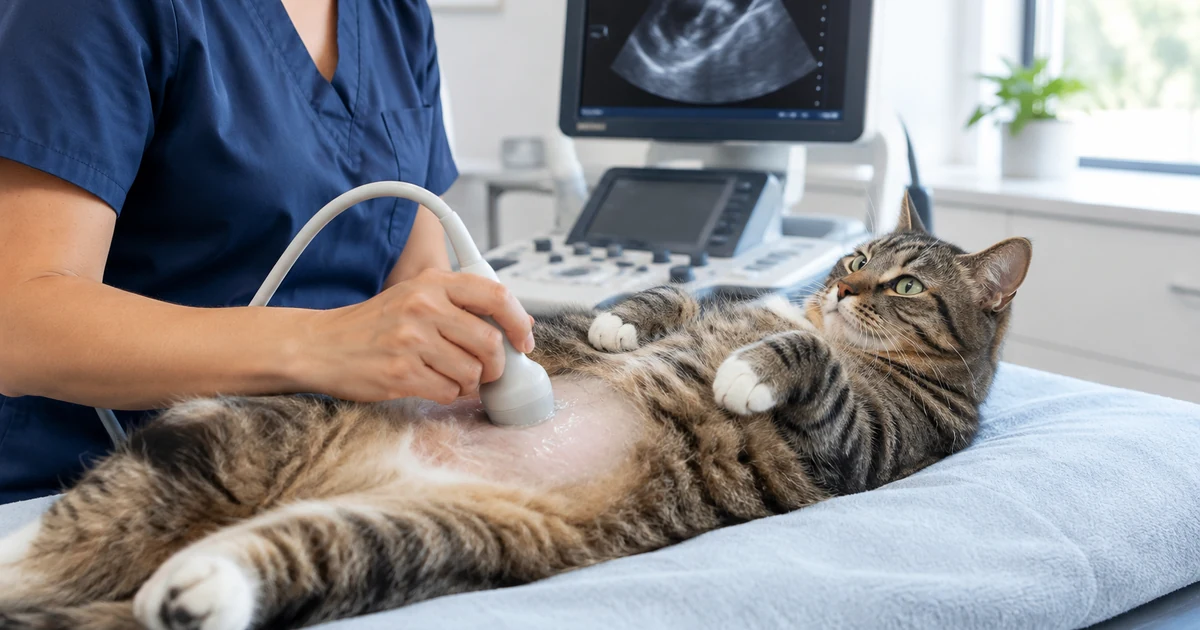
Ultrasound itself is painless and doesn’t use radiation. According to PetMD, most scans can be done without sedation; it’s mainly used when a pet is too anxious or uncomfortable to lie still, or when a sample will be collected.
General Vet vs. Specialist vs. Emergency Hospital
Where the scan is done changes the price as much as the type of scan. For the same full abdominal study, here’s roughly what each setting charges, scan plus exam or consult.
| Where it’s done | Typical total | Notes |
|---|---|---|
| General vet (in-house ultrasound) | $300–$600 | About $400 typical; images may be sent to a radiologist |
| Mobile ultrasound service at your vet | $350–$650 | A traveling specialist scans at your regular clinic |
| Specialty or referral hospital | $450–$900 | Scan by a board-certified radiologist, plus consult fee |
| Emergency hospital | $400–$900+ | ER exam fee is added; nights and weekends cost more |
Specialist scans cost more because a radiologist reads every organ in detail and writes a formal report. Many general practices own an ultrasound machine for quick checks but refer complex cases. In an emergency, vets often start with a short AFAST scan, which is cheaper and fast. See our emergency vet cost guide for ER exam fees and typical bills.
What Affects the Cost of a Cat Ultrasound
Type and length of the scan
A focused bladder check can take a few minutes, while a complete abdominal study or echocardiogram can take 30 to 60 minutes. Longer scans cost more.
Who performs and reads it
A board-certified radiologist or cardiologist typically charges 40% to 80% more than a general vet. Some clinics include remote interpretation in the price, while others bill it separately.
Sedation
Most cats tolerate an ultrasound awake, but nervous or painful cats may need light sedation, adding $50–$200. Sedation is more common when a needle sample is taken.
Region
City prices vary widely. Catster lists local examples from about $189–$250 in Boise, Idaho, to $475–$675 in San Jose, California. Use the region selector in the estimator above to adjust.
Extra tests
Ultrasound is often one piece of a workup. Bloodwork, urinalysis, X-rays or a guided sample can double the visit total, so ask for an itemized estimate before the appointment.
Why Vets Order a Cat Ultrasound
Your vet chooses imaging based on your cat’s exam and history, so only they can say whether an ultrasound is the right next step. In general terms, ultrasound is used to look at soft tissues that don’t show up well on X-rays. Common reasons include:
- Looking at the size and structure of the kidneys, liver, spleen and intestines
- Checking the bladder for stones, sludge or thickening, or collecting a sterile urine sample
- Following up on abnormal bloodwork or an X-ray finding
- Evaluating the heart, for example when a murmur is heard or before anesthesia in some cats
- Looking for fluid in the belly or chest after an accident
- Confirming pregnancy and counting kittens
An ultrasound shows what organs look like, but it doesn’t always give a final answer. Your vet may recommend a sample or another test depending on what the scan shows.
Cat Ultrasound vs. X-Ray vs. CT Scan
Each imaging test shows different things, and vets often combine them. Here’s how they compare on cost and use.
| Test | Typical cost (cat) | Best for | Sedation / anesthesia |
|---|---|---|---|
| X-rays (2–3 views) | $150–$300 | Bones, lungs, heart size, stones, swallowed objects | Sometimes sedation |
| Ultrasound | $250–$600 | Soft-tissue detail of organs, heart function, fluid | Usually awake; sometimes sedation |
| CT scan | $1,000–$2,500 | Detailed 3D images, complex cases, surgery planning | General anesthesia |
CareCredit’s 2025–2026 cost study lists national averages for cats of about $158 for X-rays (two to three views), $323 for an ultrasound and $1,144 for a CT scan. PetMD explains that X-rays are better for bones, while ultrasound shows soft tissue and moving organs in real time, such as a beating heart. For more on the first test, see our cat X-ray cost guide.
Could pet insurance cover a bill like this?
Accident & illness plans typically reimburse 70–90% of eligible vet costs after the deductible, if the condition is not pre-existing and the waiting period has passed. Premiums for dogs average about $62/month and for cats about $32/month (NAPHIA, 2025).
Coverage is subject to each policy’s terms, exclusions and state availability.Does Pet Insurance Cover a Cat Ultrasound?
Usually, yes, when the ultrasound is part of diagnosing a covered accident or illness. Most accident and illness plans treat diagnostic imaging like any other eligible vet cost, subject to your deductible and reimbursement rate.
- Accident and illness plans: Typically reimburse 70% to 90% of eligible diagnostic costs after the deductible, including the scan, sedation and interpretation when tied to a covered condition.
- Accident-only plans: Cover imaging after an injury, but not for an illness workup.
- Pre-existing conditions: A problem noted in your cat’s records before coverage started is generally excluded, including follow-up scans for it.
- Waiting periods: Illness coverage usually starts after a waiting period of around two weeks.
- Wellness add-ons: Routine screening, such as a breed heart screen, is not covered by standard plans and is rarely included in wellness add-ons.
MetLife Pet’s published claim examples show cat ultrasound bills of $300, $450 and $475. Coverage is subject to each policy’s terms. Our pet insurance cost guide explains what cat plans typically cost per month.
When It’s an Emergency
An ultrasound is usually scheduled, but some situations can’t wait. Contact your vet or an emergency hospital now if your cat is breathing with an open mouth or with effort, has collapsed, has been hit by a car or fallen, has a swollen and painful belly, or is a male cat straining in the litter box with little or no urine. In these cases the ER team decides which tests are needed, and a quick AFAST scan may be part of the first workup.
Questions to Ask Before Your Cat’s Ultrasound
A few questions up front can prevent surprises on the bill and help you plan.
- Is this a focused scan or a complete abdominal (or heart) study?
- Who will perform the scan, and who will read the images?
- Is a written radiologist or cardiologist report included, or billed separately?
- Might my cat need sedation, and what would it add?
- If a sample is taken during the scan, what are the lab fees?
- Should my cat skip breakfast or avoid using the litter box beforehand?
- When will results be ready, and is a follow-up visit included?
PetMD advises fasting only if your vet asks you to, and suggests getting your cat used to the carrier ahead of time to make the visit calmer.
How to Save Money on a Cat Ultrasound
- Ask what kind of scan is planned. A focused scan may answer a simple question for less than a full abdominal study, if your vet agrees it’s enough.
- Ask about a mobile ultrasound service. A visiting specialist at your regular clinic can cost less than a referral hospital visit and consult.
- Request an itemized estimate that lists the exam, scan, sedation, interpretation and any samples, so you can compare like for like.
- Bundle tests. Doing a guided urine sample during the scan can avoid a separate visit fee.
- Check vet schools. University teaching hospitals provide specialist imaging, sometimes at lower fees.
- Bring previous records and images to a referral visit to avoid repeating tests.
- Spread the cost with CareCredit or Scratchpay. See how to pay for vet bills for more options.
Comparing costs for a dog? See our dog ultrasound cost guide, or our cat vet visit cost guide for exam fees.
Frequently Asked Questions
How much does a cat ultrasound cost?
Most cat ultrasounds cost $250–$600 at a general vet, and about $400 is typical for a full abdominal scan with the exam. CareCredit’s 2025–2026 cost study lists a national average of $323 for the scan itself. Specialist and emergency scans cost more.
How much is an abdominal ultrasound for a cat?
A full abdominal ultrasound typically costs $250–$500 for the scan at a general vet, or $450–$800 with a board-certified radiologist. Add an exam or consult fee, and sedation if your cat needs it.
How much does a cat echocardiogram cost?
Published prices from U.S. cardiology services mostly fall between $550 and $750 for an echocardiogram with a cardiologist’s report. A full workup with exam and chest X-rays at a university hospital can cost $800–$1,200.
Does my cat need to be sedated for an ultrasound?
Often not. Most cats can be scanned awake while lying on a padded table. Your vet may suggest light sedation, usually $50–$200, if your cat is very stressed, in pain or needs a sample taken.
Is an ultrasound better than an X-ray for cats?
They show different things. X-rays are better for bones, lungs and some stones, while ultrasound shows the inside of soft-tissue organs and the heart in motion. Vets often use both, and your vet will choose based on your cat’s situation.
Does pet insurance pay for a cat ultrasound?
Accident and illness plans usually reimburse ultrasounds used to diagnose a covered condition, after the deductible. Scans related to pre-existing conditions and routine screening are generally not covered. Check your policy’s terms.
Not veterinary advice. Prices are estimates for budgeting, not quotes. Ask your veterinarian for a written, itemized estimate. If your pet is injured, in pain or acting unwell, contact your vet or an emergency animal hospital right away.